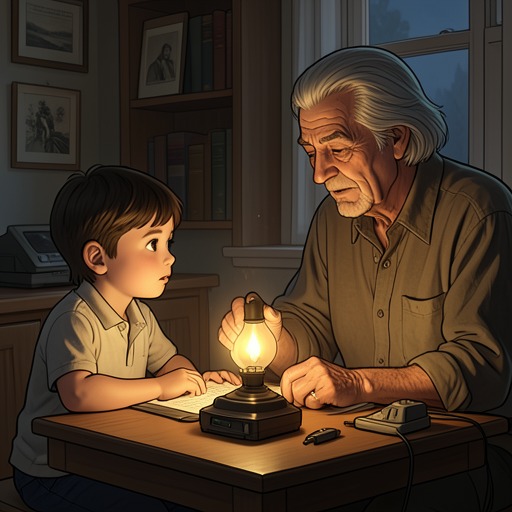
Storytelling and imagination
All the Light We Cannot SeeStorytelling and imagination in the novel are not escapes from history so much as ways of meeting it: a reader follows a fictional voyage while war closes in, a broadcast carries that voyage into unknown rooms, and a remembered recording survives long after its speaker is gone. Through Marie-Laure LeBlanc’s readings from Twenty Thousand Leagues Under the Sea, the book links imaginative attention to the fragile possibility of comfort and connection. Its stories offer no guarantee of rescue or even of being heard. Their power lies instead in making room for another mind, another future, and questions that cannot be settled from within the present moment.
Reading Against the Uncertain Future
Every afternoon, Marie-Laure reads to Etienne LeBlanc from the second part of Twenty Thousand Leagues Under the Sea. The routine has carried them through ten thousand leagues in three and a half months, and both have reached unfamiliar territory in the novel and in their own lives. Professor Aronnax’s account of where the journey is going becomes a way to frame their own uncertainty: the future is something they can ask about, though neither the characters in the book nor the listeners beside it can know what it holds. The repeated reading gives time a measure, but not an answer.
The contrast between a fictional voyage and the daily approach of the Americans sharpens that effect. Each morning brings the sense that the Americans are nearer and the Germans more frayed; each afternoon brings Marie-Laure back to Verne’s imagined sea. The reading does not make the military situation less real. Instead, it places a second unfolding narrative beside it, one in which danger can be followed through words and chapters. The listeners’ progress through the book becomes a shared activity within a world whose larger course remains beyond their control.
That imaginative habit extends from books to the small creatures in Harold Bazin’s grotto. As the tide rises, Marie-Laure notices barnacles, an anemone, and a Nassarius snail. She touches the snail as lightly as she can; it withdraws into its shell, then emerges and continues across the pool. Her inward wondering about whether it lives only in the present or worries about what comes next echoes the uncertainty she has just encountered through Professor Aronnax. The scene does not claim to know what the animal thinks. It makes the limits of such knowledge part of the imaginative act: Marie-Laure attends to another life while recognizing that its inner experience remains inaccessible.
The Book Carried by Radio
By 12 August 1944, reading has become broadcasting. Marie-Laure has read seven of the final nine chapters of Twenty Thousand Leagues Under the Sea into the microphone. The novel’s events have grown stark: Captain Nemo escapes the giant squid, faces a hurricane, rams a warship, and later plays a mournful dirge while the Nautilus lies in the sea. The sequence of peril and music unfolds within the besieged city, where a German downstairs has shouted in frustration and then fallen silent. The book’s imagined dangers and the immediate danger in the house are distinct, but the broadcast makes them audible within the same tense present.
Marie-Laure cannot know who is listening. She imagines that the broadcast may comfort Etienne, crouched in a cellar with a hundred men, or reach American soldiers in the fields as they clean their weapons. The possibilities matter precisely because they remain possibilities; the text does not confirm that any of these listeners hears her. Her relief at nearing the end of the book coexists with that uncertainty. Storytelling here is an act sent outward without assurance of reception, and its effect cannot be measured by the speaker.
The novel makes that uncertainty recur through the question of Captain Nemo’s fate. Werner Pfennig asks Marie-Laure whether Nemo survives the whirlpool. She answers by weighing no, yes, and not knowing, then suggests that the uncertainty may be the point: she did not want Nemo to die, though she recognizes him as mad. Her response gives imagination a form more complex than simply believing a story’s outcome. A reader can feel attachment to a character while remaining unable, or unwilling, to settle what happens next. The unresolved ending is not a gap to be hurried past; it is what keeps the question alive between them.
Imagining Across Isolation
Werner’s listening gives the broadcast another dimension. On the evening when the Americans have the Germans pinned against the sea, he looks from the hotel toward the city and imagines Marie-Laure moving through it with her cane. He cannot know where she is or what she is doing. His vision of her is an act of imagination shaped by distance and concern, and his thought that he has at least protected the secrets of her house shows how he interprets his own limited action. The scene sets his imagined picture against the military landscape outside: the city is visible, but the person he thinks of remains beyond his sight.
Earlier, in the cellar, Werner carries the radio and battery to Frank Volkheimer and places headphones over his ears. The passage from listening alone to sharing the headphones turns sound into a practical means of contact in darkness. Later, when Volkheimer puts the headphones on Werner and urges him to listen, Werner recognizes Clair de Lune. The name opens briefly into the image of Claire, a girl made clear and almost transparent in his association. Music, like the spoken story, prompts an inward image; neither requires the listener to see its subject in front of him. In these scenes, imagination does not overcome physical confinement, but it allows thought and sound to cross its boundaries.
The transmission’s meaning also depends on what remains unknown to Marie-Laure. She can speak into the microphone, but cannot verify that her imagined audience is present, much less learn what the story means to them. Werner’s act of listening supplies one possible connection across distance, while the text withholds any simple equation between broadcasting and rescue. Communication can matter without producing a visible response; the silence after a voice is sent out does not prove that it has gone nowhere.
Stories That Survive Their Speakers
After the war, Marie-Laure recalls that Etienne traveled back to Saint-Malo after selling the house and salvaged the one remaining recording of her grandfather. She identifies it as being about the moon. In the later meeting with Jutta Pfennig and Francis, that recovered voice becomes part of a conversation about the recording and what lies on the other side of light. The book thus returns storytelling to a material object: a recording preserved when nearly everything else might have disappeared. What survives is not only the fact that someone once spoke, but a voice that can still prompt questions in another time.
The ending does not resolve those questions into a single interpretation. The recording, the little house, the sound of snails sliding along glass, and the remembered words about the moon remain together in the scene. Their juxtaposition lets imagination move between what can be touched, what can be heard, and what cannot be known directly. Across the novel, a printed book, a radio performance, music, and a salvaged voice each carry experience beyond the moment in which it was first made. None guarantees understanding. Each offers a way for one person’s words or images to continue inside another person’s attention.